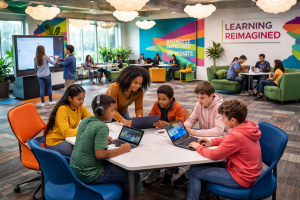
 In a time when families are seeking more holistic, relevant, and child-centered ways for their children to learn and thrive, alternative learning models are emerging as vital pathways toward responsive, future-ready learning environments. These models challenge conventional systems by honoring each child’s unique strengths, needs, and rhythms—while also restoring something long missing from many modern school settings: authentic community connection.
A Personal Journey Rooted in Trust and Community
Our family has been homeschooling for over 16 years, long before it became a more visible or widely accepted choice. What started as a desire to meet our children’s unique learning styles quickly became a deeper commitment to creating responsive, connected, and joyful learning experiences not just for our family, but for others, too.
Over the years, we’ve supported countless families many of whom felt isolated or uncertain by building community spaces, learning pods, and co-ops that honor relationship, trust, and creativity. Back then, choosing something outside the norm meant facing skepticism. But now, more families are realizing that learning doesn’t need to be confined to rigid systems to be effective—or transformative.
Restoring Community Through Small-Scale Learning
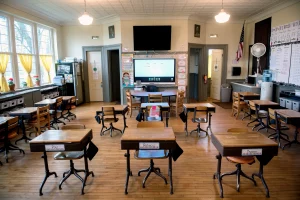
One of the most powerful shifts in education today is the return to the “one-room schoolhouse” ethos. Unlike large, impersonal school systems, these smaller learning environments foster:
- Genuine relationships across ages
- A shared sense of responsibility
- Natural collaboration and mentorship
- Daily experiences of community care
When learning happens in human-scale environments—be it a home-based pod, a church basement co-op, or a community learning hub—students aren’t just receiving information; they’re growing up in ecosystems of support and belonging.
In contrast, larger schools often struggle to foster true connection. Community isn’t always organic—it’s scheduled, performative, or diluted by the size of the institution. But in smaller, intentionally designed learning communities, connection becomes a daily, lived experience.
The Benefits of Alternative Learning Models
From Montessori and project-based microschools to unschooling and hybrid models, alternative education allows children to:
- Learn at their own pace
- Engage deeply with topics they care about
- Build confidence through autonomy
- Strengthen relationships with family and peers
These models are not fringe—they are future-ready, preparing learners to adapt, collaborate, and lead in a world that values creativity, emotional intelligence, and resilience.
Why Parent Choice Matters
Empowering families to choose—or build—the learning environments that work for them is essential. Parent choice isn’t about competition between systems; it’s about recognizing that education is not one-size-fits-all.
When families have choice:
- Children thrive emotionally, socially, and academically
- Learning reflects family values and cultural identities
- Communities innovate around what works, not what’s imposed
We’ve seen firsthand how transformational it is when parents move from feeling stuck to feeling empowered…whether they choose homeschooling, a hybrid program, or a cooperative model rooted in community.
Addressing Access and Equity
As we grow these options, we must stay vigilant about inclusion. Many alternative models began as private or resource-dependent, making them inaccessible for some families. To ensure equity:
- Public funding should follow the child, not the system
- Community-based programs must reflect and serve all communities and socioeconomic realities
- Support systems (like mentoring, legal guidance, and resource hubs) must be built with marginalized families at the center
 A Call to Reconnect Learning with Life
As more families turn toward alternative education, the vision is clear: responsive, future-ready learning environments that honor individual needs and collective care.
Let’s not simply tweak existing systems—let’s center our communities, trust families, and build education from the ground up. The revival of the one-room schoolhouse spirit is not nostalgia…it’s a blueprint for connection, collaboration, and wholeness.
Interested in starting your own learning community or exploring homeschool support?
Let’s build something together—rooted in trust, connection, and the belief that every child deserves to thrive.